
The Brief Special Edition: On Minnesota and Human Rights
Hi friends,
I had originally intended to write about the highs and lows of the annual meeting of the World Economic Form in Davos, Switzerland last week, but for reasons that are probably obvious, that just didn’t feel right to me anymore (though I will give a quick shout out to the speech by Canadian Prime Minister Mark Carney, which you can read or watch here—scroll down the page to find the video).
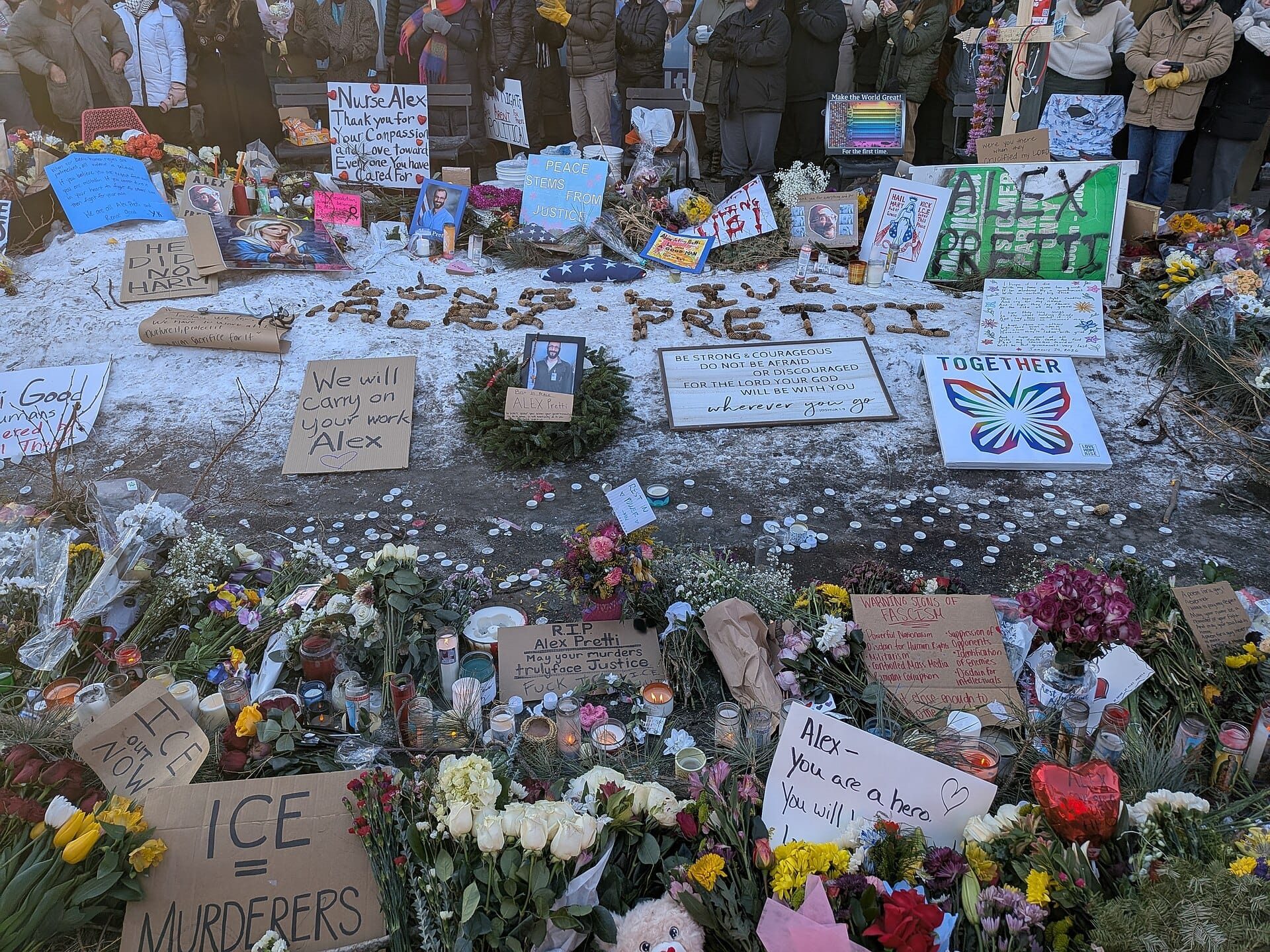
Instead, given recent events in Minnesota—including the abduction of a five-year-old boy, the mass arrest and detention of migrants, and the murders of Renée Good and Alex Pretti, all at the hands of federal agents—I want to take a moment to talk about human rights.
On Friday, the U.N. Office of the High Commissioner for Human Rights issued a press release titled “USA migrant crackdown: UN Human Rights Chief decries dehumanisation, harmful policies and procedures,” which you can read in its entirety here. (Note that this press release was issued on January 23—a few weeks after the killing of Renée Good on January 7, but the day before the January 24 killing of Alex Pretti.)
The press release is notable in no small part because of its forceful tone. The second paragraph begins with a long quote from High Commissioner Volker Türk, who states:
“Individuals are being surveilled and detained, sometimes violently, including at hospitals, churches, mosques, courthouses, markets, schools, and even within their own homes, often solely on mere suspicion of being undocumented migrants. Children are missing school and pediatric appointments for fear of never seeing their parents again.
Those who dare to speak up or protest peacefully against heavy-handed immigration raids are vilified and threatened by officials, and on occasion subjected to arbitrary violence themselves.
I am astounded by the now-routine abuse and denigration of migrants and refugees. Where is the concern for their dignity, and our common humanity?"
The High Commissioner also called for an “independent and transparent investigation into the concerning rise in the number of deaths in U.S. Immigration and Customs Enforcement custody," before concluding, “[t]he U.S. has the obligation to comply with international human rights law and international refugee law. Migration enforcement must always respect due process, protection from arbitrary detention, the principle of non-refoulement, equality and non-discrimination, and protection of the family.”
If you’re able, I highly recommend reading the entire press release. I also want to highlight a few of the human rights and fundamental freedoms that the High Commissioner references there. But first:
What is the High Commissioner for Human Rights?
The position was created by the U.N. General Assembly in December 1993. The High Commissioner is appointed by the U.N. Secretary General, and approved by the General Assembly, for a term of four years, with the possibility of renewal for a second four-year term. The High Commissioner has “principal responsibility for United Nations human rights activities under the direction and authority of the Secretary General,” and must be “a person of high moral standing and personal integrity and shall possess expertise, including in the field of human rights, and the general knowledge and understanding of diverse cultures necessary for impartial, objective, non-selective and effective performance of the duties of the High Commissioner.”
What does the High Commissioner for Human Rights do?
The same General Assembly resolution that establishes this position also provides a high-level description of the High Commissioner’s duties. I won’t go through all of them here, but some relevant responsibilities include promoting and protecting effective enjoyment by all of all civil, cultural, economic, political, and social rights; carrying out the tasks assigned to them by competent U.N. bodies, and making recommendations to those bodies; engaging in a dialogue with governments in the implementation of their mandate with a view to securing respect for all human rights; enhancing international cooperation for the promotion and protection of human rights; and coordinating the human rights promotion and protection activities throughout the United Nations system.
What human rights does the High Commissioner mention in this press release?
There are a number, some listed explicitly and some more obliquely, but they include:
The right to life
Article 6 of the International Covenant on Civil and Political Rights (ICCPR) provides, “Every human being has the inherent right to life. This right shall be protected by law. No one shall be arbitrarily deprived of his life.”
The right not to be subjected to arbitrary arrest, detention, or exile
This right can be found in Article 9 of the Universal Declaration of Human Rights (UDHR) and Article 9 of the ICCPR, and includes the right not to be deprived of liberty “except on such grounds and in accordance with such procedure as are established by law.”
The right to asylum and the principle of non-refoulement
Article 14 of the UDHR addresses the right to “seek and enjoy in other countries asylum from persecution.” The Convention Relating to the Status of Refugees also articulates in Article 33 the principle of non-refoulement, providing that “[n]o Contracting State shall expel or return (‘refouler’) a refugee in any manner whatsoever to the frontiers of territories where his life or freedom would be threatened on account of his race, religion, nationality, membership of a particular social group or political opinion.”
(In other words, people have a right to see asylum, and if they have a well-founded fear of persecution, they cannot be sent back to the country they are fleeing—or, indeed, to a third country where they could face torture or persecution.)
The right to equal protection of the law and non-discrimination
Under Article 7 of the UDHR, “All are equal before the law and are entitled without any discrimination to equal protection of the law.” Article 26 of the ICCPR also includes the provision, “In this respect, the law shall prohibit any discrimination and guarantee to all persons equal and effective protection against discrimination on any ground such as race, colour, sex, language, religion, political or other opinion, national or social origin, property, birth or other status.”
The right to protection from arbitrary interference with privacy, family, home, or correspondence
Article 12 of the UDHR provides, “No one shall be subjected to arbitrary interference with his privacy, family, home or correspondence, nor to attacks upon his honor and reputation. Everyone has the right to the protection of the law against such interference or attacks.” This language is echoed in Article 17 of the ICCPR.
Are there other human rights that apply to what’s happening in Minnesota (and across the U.S. as a whole)?
Yes! A lot of them! But I’ll highlight a few more here:
Freedom of movement
Under Article 12 of the ICCPR, “Everyone lawfully within the territory of a State shall, within that territory, have the right to freedom of movement and freedom to choose his residence.”
Yes, “everyone” includes people with Temporary Protected Status, people with pending asylum petitions, and people who are afraid to leave their homes because ICE is indiscriminately snatching people of color off the streets.
The right to be expelled from a state only in accordance with the law
I’m just going to reproduce article 13 of the ICCPR here in its entirety:
“An alien lawfully in the territory of a State Party to the present Covenant may be expelled therefrom only in pursuance of a decision reached in accordance with law and shall, except where compelling reasons of national security otherwise require, be allowed to submit the reasons against his expulsion and to have his case reviewed by, and be represented for the purpose before, the competent authority or a person or persons especially designated by the competent authority.”
(I’ll just note that even though this Article and Article 12 refer to people “lawfully” in the territory, that does not mean that undocumented migrants don’t still enjoy other rights, such as the right to life, and the right not to be subject to arbitrary arrest and detention, as well as the right not be sent back to a country where they might face torture or persecution.)
Freedom of expression
Under Article 19 of the UDHR, “Everyone has the right to freedom of opinion and expression; this right includes freedom to hold opinions without interference and to seek, receive and impart information and ideas through any media and regardless of frontiers.” Similar language also appears in Article 19 of the ICCPR.
The right to peaceful assembly and freedom of association
Both the UDHR and the ICCPR recognize the rights to peaceful assembly and freedom of association (see Article 20 of the UDHR and Articles 21 and 22 of the ICCPR). This includes nonviolent protests.
Why does any of this matter if these rights are being violated?
Here’s the thing: there’s a reason why you won’t see human rights lawyers refer to countries “eliminating” or “taking away” human rights from their citizens, and why they will instead insist on referring to those countries “violating” or “undermining the exercise of” those rights. The reason is that human rights exist independent of the tyrants, despots, and secret police who would trample on them. A president or an ICE agent or a Secretary of Homeland Security can impede our exercise of those rights to the best of their abilities—they can break up protests, fire tear gas into vans full of children, and shoot people for filming their violent arrests. But they can’t destroy the rights themselves.
Those rights carry on. Those rights are ours, by virtue of our humanity, and by the promises we have made to each other about what we value, and what we uphold. They are ours to fight for.
And even if tyrants don’t recognize them, we can. And we must.
What you can do
I’ll leave you with this today, friends: if you are feeling overwhelmed and want to find a way to help, here is a list of numerous organizations you can donate to in Minnesota, ranging from mutual aid, to legal support for migrants, to rapid response funds. Check out Stand with Minnesota here.
Sending all the support and solidarity your way.
Alexis