
The Brief: To PNG or Not to PNG
Hi friends,
There is once again quite a lot going on, including with respect to issues we’ve covered together in the past, so I have an updates post for you today! We’ll tackle tariffs, a petition to declare the U.S. Ambassador to Canada persona non grata, the Ebola outbreak, and why it doesn’t make any sense to say that the Strait of Hormuz is U.S. territory (big sigh), below.
Canada and the U.S. are negotiating over tariffs
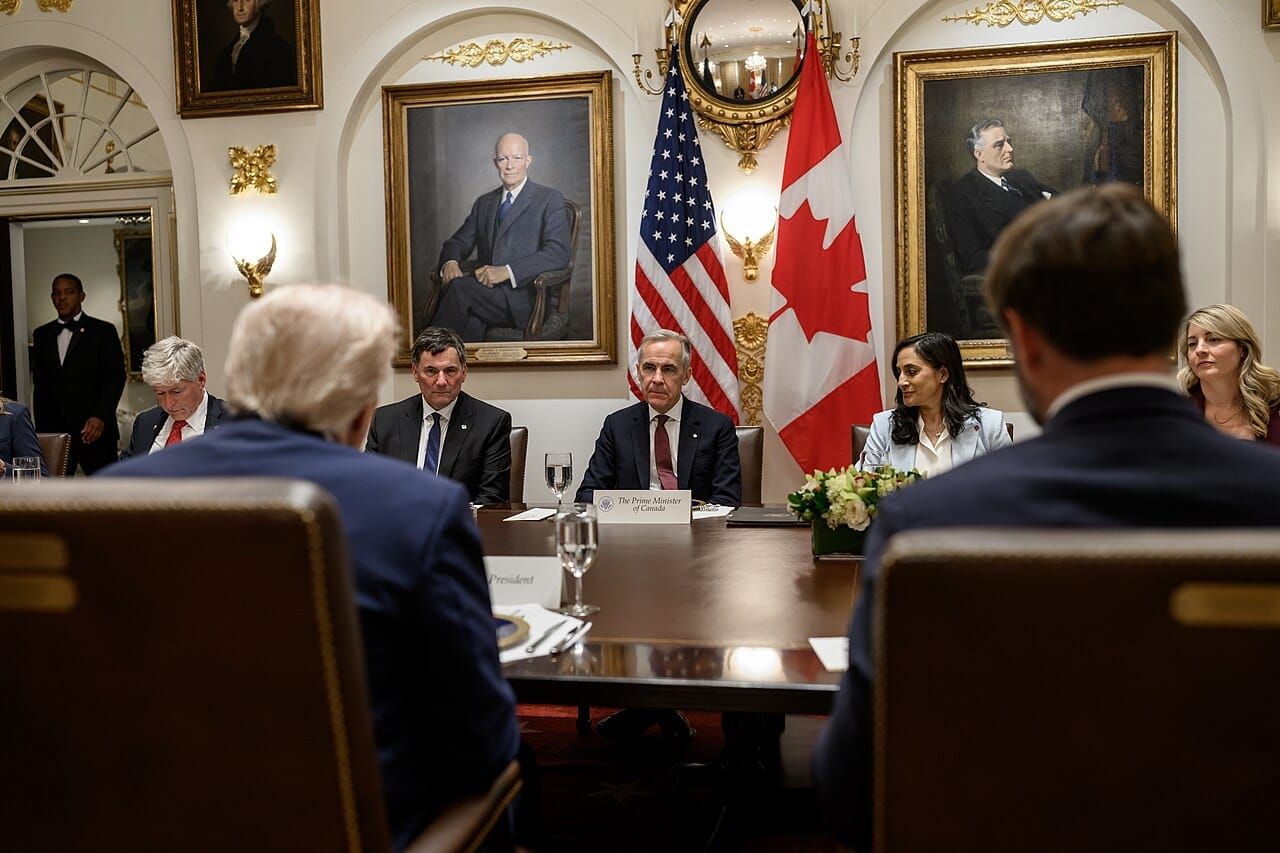
For someone who previously self-described as “not very interested in the trade part of international law,” I sure have written about tariffs a lot, and today is no exception! Our most recent tariffs coverage highlighted President Trump’s announcement that he intended to impose 50% tariffs on certain Canadian goods using Section 338 of the Tariff Act of 1930 (also known as the Smoot-Hawley Act, for reasons I refuse to google), which has never been used before.
Those tariffs are set to take effect on Wednesday, and the U.S. and Canada are reportedly trying to negotiate terms of a potential deal to prevent their imposition. In addition to the tariffs themselves, discussions include energy and defense issues and access to critical minerals, and the talks may set the stage for further discussions on an agreement to replace or update the USMCA.
However, if no deal is reached, Canadian Prime Minister Mark Carney has said that “all options are on the table” with respect to responding to U.S. tariffs. The U.S. threat to impose 50% tariffs coincides with an already low point in U.S.-Canadian relations: a Pew research survey found that in 2022, 82% of Canadians viewed the U.S. as a reliable partner, but that number has now dropped to 35%. Additionally, as of the time of this writing, nearly 220,000 Canadians have signed a petition asking the government to expel the U.S. Ambassador to Canada, Pete Hoekstra. The petition, which you can read here, highlights Ambassador Hokestra’s normalization of U.S. threats to make Canada the 51st state, and alleges that he has made “repeated interventions in Canadian political discourse inconsistent with diplomatic protocol.”
The petition calls on the government of Canada to:
- Formally declare Pete Hoekstra persona non grata and request his removal as U.S. Ambassador to Canada;
- Raise with the United States the pattern of conduct by Ambassador Hoekstra inconsistent with the Vienna Convention on Diplomatic Relations; and
- Direct a parliamentary committee to review U.S. diplomatic interference in Canadian domestic affairs.
“Persona non grata” is the term that is used to describe a declaration by a State that a member of the diplomatic staff of another country is not permitted to stay under diplomatic status, and must be recalled or barred from entering the country. (This process is also referred to as "PNGing someone," at least by me and several dozen of my former colleagues, and honestly I think it will catch on.)
The petition will likely be debated in Parliament this fall.
The Ebola outbreak in the DRC is growing
The World Health Organization (WHO) has said that the Ebola outbreak in the Democratic Republic of the Congo (DRC) is on track to surpass the deadliest in history. The outbreak has killed 2,100 people and has now spread to a sixth province in the DRC. The WHO based its estimate on the fact that this outbreak reached its current death toll “almost three times faster” than the outbreak in 2014 to 2016, which ultimately killed 11,000 people.
The Guardian reports that there are not currently any approved vaccines or treatments for this strain of the virus, known as the Bundibugyo strain. Officials are also worried that the virus could be mutating.
You can find our previous coverage of some of the factors that make this outbreak so difficult to contain here.
Things with Iran are going about how you would expect
Anyone remember the U.S.-Iran MOU? Monday marked the 60-day deadline set by the MOU to negotiate a broader peace deal between the two countries, to end the war and resolve questions related to Iran’s nuclear program. The MOU has effectively been abandoned, and while The New York Times reports that there have been “no publicly reported U.S. strikes on Iranian targets since late July,” neither has there been any progress toward some sort of new deal to end the conflict.
The most pressing dispute relates to Iran’s closure of the Strait of Hormuz: Iran insists that the language of the MOU allowed it to charge fees for ships transiting the Strait of Hormuz, and has fired on vessels attempting to transit through. The U.S. wants Iran to reopen the Strait before it makes any concessions, such as releasing frozen Iranian assets.
In one of the most bonkers claims made related to the conflict to date, President Trump stated on Friday that he was going to designate the Strait of Hormuz a territory of the United States. Specifically, he claimed, “After we finish defeating Iran, which is being very badly defeated, pretty soon I’ll be declaring the Hormuz strait a territory of the United States…Essentially, that’s what it is. We have the blockade. No ships get through unless we want them to.”
Setting aside the fact that Iran is not currently “badly defeated,” to the extent the Strait of Hormuz encompasses the territorial seas of Iran and Oman, it cannot become “territory” of the U.S. unless the U.S. also controls the adjacent land. Additionally, because the Strait of Hormuz is an international strait, it is subject to the right of transit passage, which is defined in the U.N. Convention on the Law of the Sea as “the exercise…of the freedom of navigation and overflight solely for the purpose of continuous and expeditious transit of the strait between one part of the high seas or an exclusive economic zone and another part of the high seas or an exclusive economic zone.” (UNCLOS, art. 38). (While Iran is not a party to UNCLOS, and neither is the U.S., for that matter, the U.S. considers the right of transit passage to be customary international law.)
In sum, the Strait of Hormuz cannot simply be declared "U.S. territory," in the first place because that is not what those words mean, and second because it would violate international law.
Thanks for joining us today! Barring anything bananas happening in the interim, I’ll see you back here next week.
Alexis
You can follow The Connection on Bluesky, Facebook, Instagram, LinkedIn, and Threads.