
The Brief Special Edition: Regime Change in Venezuela
Hi friends,
I’m moving up this week’s edition of The Brief by a few days, and sending it out to all subscribers, in light of this morning’s events in Venezuela. I expect a fair amount of additional information will come to light as things evolve, so watch this space, but here’s where things stand as of the time of this writing.
What do we know?
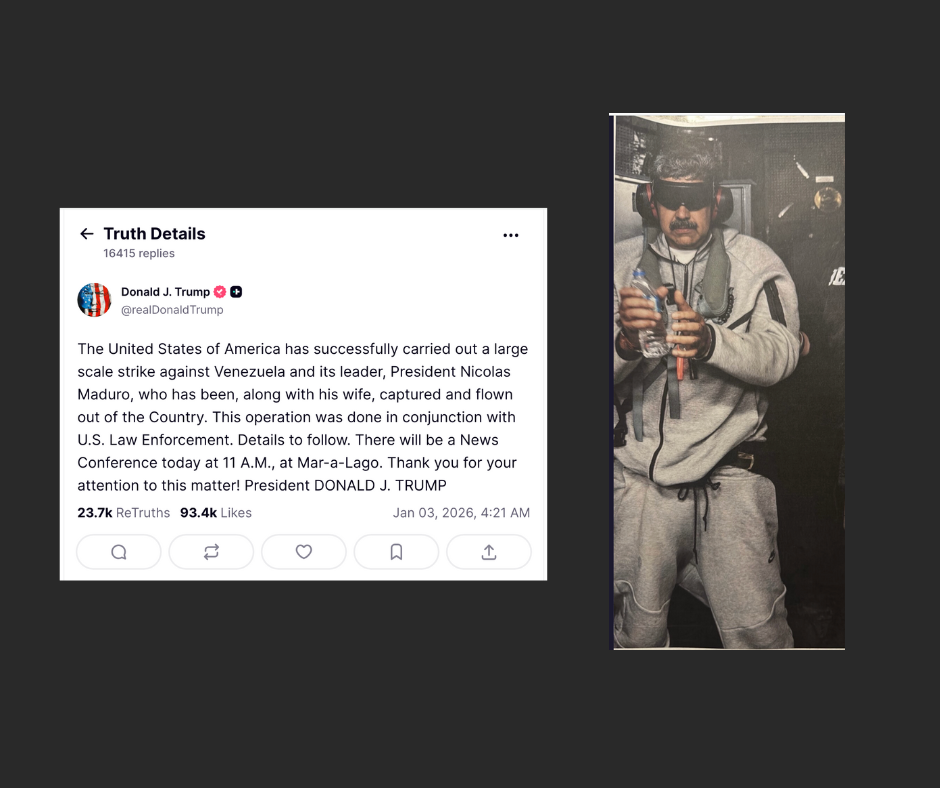
Early this morning, President Trump announced on social media that the U.S. had “successfully carried out a large scale strike against Venezuela and its leader, President Nicholas Maduro, who has been, along with his wife, captured and flown out of the Country [sic].” The New York Times reports that overnight, there were explosions at military facilities in Venezuela, including the Generalissimo Francisco de Miranda airbase and Fuerte Tiuna in Caracas, as well as near the port of La Guaira. There were also strikes outside the capital in the states of Aragua, Miranda, and La Guaira. One Venezuelan official estimates the death toll to be at least 40 people.
President Maduro and his wife were initially brought on board the U.S.S. Iwo Jima, and were later flown to New York, where they face narcoterrorism charges. The indictment against them, which has recently been unsealed, includes charges of conspiracy to import cocaine and possession of machine guns and destructive devices. Notably, the indictment does not include any reference to fentanyl, which the administration had previously cited as a justification for its military strikes on boats in the Caribbean Sea.
Many Venezuelans, including those who had previously fled the country under Maduro, are celebrating his removal. (According to the International Organization for Migration, over 20% of the population of Venezuela has left the country since 2014.) At the same time, it is unclear what Venezuela’s future will be: President Trump has stated that the U.S. is “gonna be running” Venezuela for an unspecified period of time, and that the U.S. is “not afraid of boots on the ground.” While President Trump initially stated that Venezuelan Vice President Delcy Rodríguez told Secretary of State Marco Rubio that she was willing to do what the U.S. “thinks is necessary,” Rodríguez has repeatedly and publicly said that Maduro was Venezuela’s “only president,” and that Venezuela “will never again be a colony of any empire.”
Reactions from U.S. lawmakers are largely falling along partisan lines. The Washington Post reports that while the majority of GOP House members, including Speaker Johnson, have lauded the decision to invade Venezuela, there are some notable exceptions, including Representative Marjorie Taylor Greene and Representative Thomas Massie. Many Democrats have condemned the attacks, including Democratic Senator Chris Van Hollen, who released a statement pointing out that “The American people did not ask for this act of war to bring about regime change in Venezuela—nor did Congress authorize it…Maduro is a dictator, but his regime did not pose the immediate threat necessary to warrant U.S. military action on foreign soil without Congressional approval.”
Similarly, Representative Gregory Meeks said in an interview that Secretary of State Rubio “said that there were not any intentions to invade Venezuela. So, he absolutely lied to Congress.”
Senator Tim Kaine has announced that he plans to bring a vote next week on a bipartisan resolution under the War Powers Act that would ban the use of military force against Venezuela. The Senate came within three votes of passing a War Powers Act measure last year, and could conceivably bring enough pressure to bear to move the needle on this—more on calling your reps below.
Why is this unlawful?
The attacks violate international law
Article 2(4) of the U.N. Charter provides that all U.N. members “shall refrain in their international relations from the threat or use of force against the territorial integrity or political independence of any state, or in any other manner inconsistent with the Purposes of the United Nations.” Article 51 provides for a right to individual or collective self-defense “if an armed attack occurs against a Member of the United Nations,” but as we’ve previously pointed out, there is no actual or imminent armed attack against the U.S. by Venezuela, or by drug cartels, that would justify the use of military force as a response.
The administration also appears to be arguing that its actions in Venezuela were a law enforcement operation along the lines of its 1989 invasion of Panama to capture Manuel Noriega. The Trump administration reportedly relied on a 1989 opinion by the Department of Justice’s Office of Legal Counsel (OLC), which argued that then-President Bush could, as a domestic matter, violate international law (specifically, the U.N. Charter) in order to have the F.B.I. carry out an arrest of a foreign national overseas. Essentially, the opinion takes the position that the U.S. could disregard not just international law, but the supremacy clause of the Constitution, which provides that that the laws of the United States, including treaties entered into by the United States, are the supreme law of the land. To support this line of reasoning, OLC argued that the U.N Charter was not “self-executing” as a matter of domestic law (in other words, that it needed implementing legislation passed by Congress before a U.S. court could enforce it), and thus the executive branch was not required to abide by it.
However, legal experts have pointed out that the 1989 opinion misunderstands both the concept of non-self-executing treaties, as well as historical understandings of the U.N. Charter. I won’t go further into the weeds on this here, but if you’re interested, I can recommend Just Security pieces on this by Brian Finucane and Ryan Goodman. For our purposes, suffice it to say that even if the 1989 OLC opinion were taken at face value, and the U.N. Charter was not considered to be binding U.S. law under the supremacy clause of the Constitution, the violation of international law would remain. (It’s also worth noting, as the New York Times does, that after the U.S. invasion of Panama, the U.N. General Assembly called U.S. actions “a flagrant violation of international law.”)
Congress has not authorized the use of force in Venezuela
Nor are the strikes, or indeed any occupation of Venezuela, justifiable under domestic law. Congress, not the President, has the power to declare war. While the Executive Branch has historically argued that it can conduct certain strikes without congressional authorization pursuant to Article II of the U.S. Constitution, even under that framework, the nature, scope, and duration of those actions must not rise to the level of a war under Article I. In this case, U.S. troops were introduced into Venezuela (and some reportedly suffered injuries), strikes were conducted in the territory of the state, and the U.S. President has made public statements about leaving U.S. boots on the ground indefinitely and taking over the Venezuelan oil industry, all of which undermine any argument that U.S. actions do not require congressional authorization.
What to watch out for
Whether the Maduro regime, via the Vice President, maintains power in Venezuela, or whether the opposition asserts control (and whether the U.S. plays a role in determining that outcome); whether U.S. troops return to Venezuela and under what circumstances; whether Republican support for the invasion holds firm; how Maduro’s indictment proceeds and whether he successfully asserts head of state immunity (a tricky prospect, since the U.S. does not recognize his government); whether President Trump continues to make similar threats against Cuba and Colombia.
What you can do
Folks in the U.S.: you can call your representatives! You don’t need a complicated script, either—if you oppose U.S. actions in Venezuela, you can simply ask your representatives to condemn the strikes, and ask them to support a War Powers Act resolution limiting the use of the U.S. military both in Latin America and in the waters of the Caribbean Sea and Eastern Pacific.
Thanks for reading, friends. I'll do my best to keep you posted as things unfold this week--make sure to follow The Connection on social media if you don't already!
Alexis
You can follow The Connection on Bluesky, Facebook, Instagram, LinkedIn, and Threads.